Zero Liquid Discharge: from compliance cost to circular asset
ZLD has shifted from an optional environmental strategy to a condition of operating in India. Treated the right way, the same plant that satisfies the regulator can also pay part of its own way back.
India holds roughly 4% of the world's freshwater while supporting close to 18% of its population. That arithmetic sits behind every tightening discharge norm of the last decade. The Central Pollution Control Board (CPCB) introduced Zero Liquid Discharge (ZLD) guidelines in 2015 for four high-load sectors — textiles, tanneries, distilleries and pulp & paper — and for textile units the draft mandate applied above 25 KLD of effluent. In practice, a Consent to Operate now increasingly depends on a functioning zero-discharge system.
The point worth making to any plant owner is this: ZLD is no longer a question of if. As one industry summary put it in 2026, it has moved from optional strategy to regulatory expectation across multiple sectors. The useful question is how to build it so it is not purely a cost centre.
What "zero" actually takes
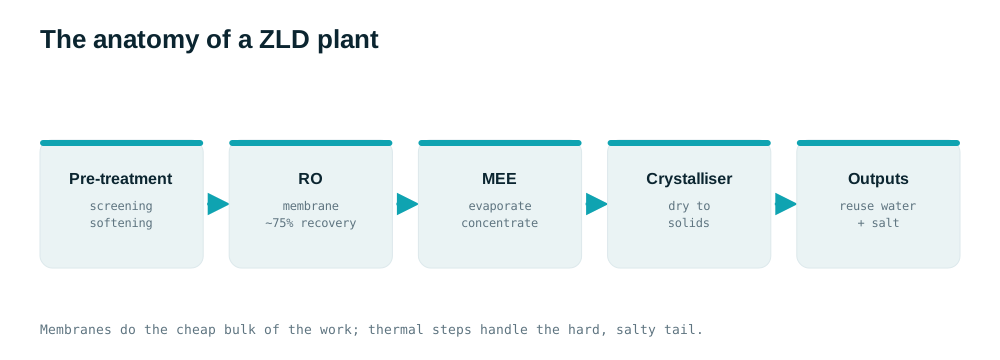
A ZLD line is a sequence, each step handling what the previous one could not:
- Pre-treatment — screening, softening and chemical conditioning so the membranes never see what would foul them
- Reverse osmosis (RO) — the workhorse, recovering the bulk of clean water at around 75% recovery
- Multi-effect evaporation (MEE) — boils down the RO reject into a concentrated brine
- Crystalliser — dries the last of it to a handleable solid
Built up across those stages, recovery climbs from the RO figure into the 90–98% range that full ZLD demands.
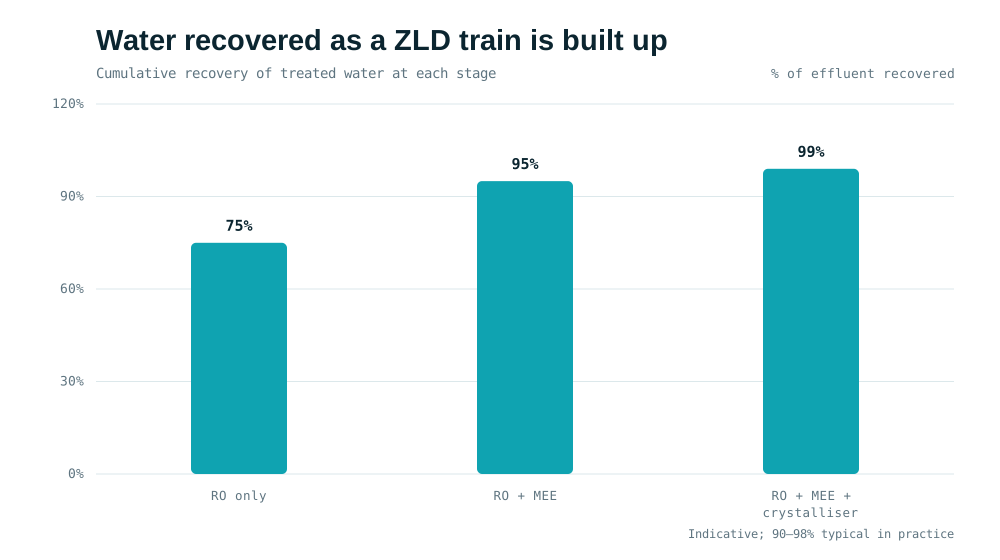
The economics live in that curve. Membranes recover the cheap, easy bulk of the water at a fraction of the energy. Thermal steps — MEE and crystallisation — handle the hard, salty tail, and they are expensive and energy-intensive. So the design instinct is always the same: push membrane recovery as high as the chemistry allows before the brine ever reaches an evaporator.
The upside hiding in the brine
ZLD's reputation as a pure cost ignores what comes out of the crystalliser. Many systems recover salts and chemicals that can be reused or sold: textile units reclaim sodium sulphate or common salt for the dye house, tanneries recover chromium, and chemical plants extract usable compounds. That by-product stream genuinely offsets part of the running cost — and the recovered water itself displaces fresh intake, which in a water-stressed cluster is a cost and a risk avoided.
Treated as a circular system rather than an end-of-pipe penalty, a ZLD plant returns water to the process and salt to the dye house — two purchases the factory no longer has to make.
Designing it so it pays
A few principles separate a ZLD plant that merely complies from one that earns its keep:
- Segregate streams at source. Keeping high-TDS and high-colour streams apart from lightly loaded ones means the expensive thermal train only ever sees the small, concentrated fraction.
- Protect recovery with pre-treatment discipline. Antiscalant dosing and tight SDI control let the RO run at higher recovery for longer between cleans.
- Right-size the thermal tail. Over-built evaporators burn money every hour; under-built ones cap recovery. The split between membrane and thermal recovery is the single biggest cost decision in the design.
What a ZLD train actually looks like
A working zero-discharge plant is a sequence, and the order is dictated by cost per cubic metre. After conventional primary and secondary treatment, the bulk of the water is removed by reverse osmosis — often a two-pass arrangement using high-rejection brackish or sea-water elements, pushed to high recovery with careful antiscalant dosing and softening ahead of it. RO is the cheap stage: it dewaters with electricity. Only the last, stubborn fraction of the stream — now a hot, hyper-saline reject — goes to the thermal stage, a multiple-effect evaporator (MEE) followed by an agitated thin-film dryer (ATFD) or crystalliser that boils off the remaining water and drops out solid salt.
That division of labour is the whole economic argument. Membranes are inexpensive to run; evaporators are not. Modern ZLD systems recover 90–98% of the effluent as reusable water, and the design discipline is to push as much of the load as the chemistry safely allows onto the membranes before the evaporator ever sees it. Get the split wrong — undersize the RO, over-recover into scaling, or oversize the MEE — and the running cost balloons.
Where the money comes back
Treated the right way, a ZLD plant is not only a cost. In a water-scarce zone, recovered permeate displaces freshwater that the site would otherwise buy, pump from ever-deeper borewells, or truck in by tanker — all rising costs. The recovered salt (sodium chloride or sodium sulphate, depending on the chemistry) can sometimes be reused in process or sold rather than landfilled. And the largest return is the one that never appears on an invoice: the avoided penalty, and the avoided risk of a Consent to Operate being withdrawn and the line stopped. A plant engineered from a real effluent analysis, with recovery targets and a water-and-salt balance set before any vessel is bought, is the one that turns all three of those into a payback.
For a high-TDS effluent in a water-scarce region, ZLD is viable for the long term. The plants that struggle are the ones bolted on as an afterthought; the ones that work are engineered from a raw-water and effluent analysis, with the water balance and recovery targets set before a single vessel is bought.