Textile effluent in Gujarat: colour, TDS and the road to ZLD
Dye-house effluent is among the hardest industrial water to treat — and among the most tightly regulated. In Gujarat's textile clusters, ZLD is now the cost of doing business.
Few industrial effluents are as visibly, chemically difficult as a textile dye house's. It arrives hot, deeply coloured, alkaline and salty — and in Gujarat's processing clusters, from Ahmedabad to Surat and the dyeing belts beyond, treating it to zero discharge is now a condition of operating.
What's actually in the stream
Textile dyeing and finishing effluent typically carries TDS of 5,000–15,000 mg/L or more, a pH of 9–11, and substantial colour from spent dye. The salt comes from the dyeing process itself; the colour and organics from unfixed dye and auxiliaries. None of it is welcome downstream, and discharge norms across Indian textile clusters now require demonstrated reuse — often around 90% — with no off-site discharge.
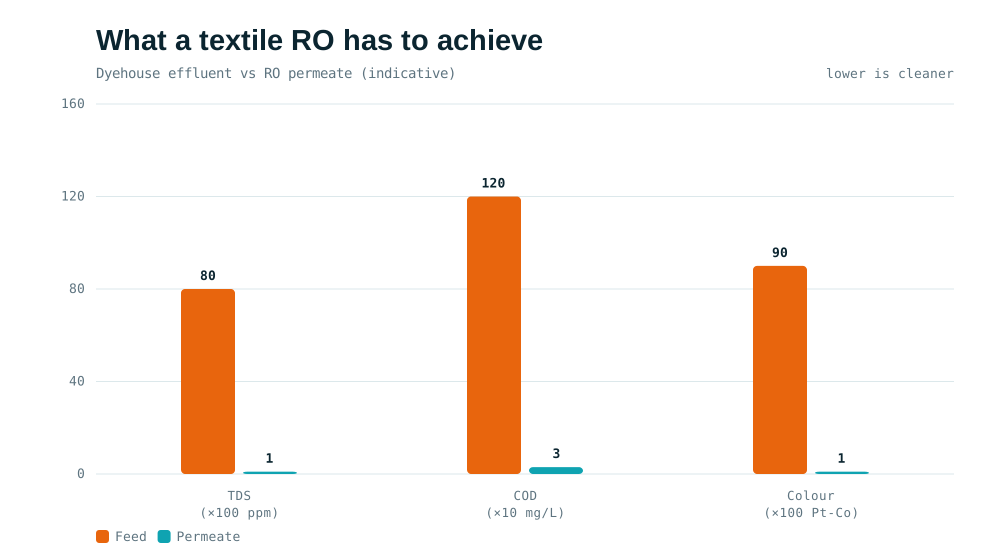
That contrast is the whole task in one picture. The feed is loaded; the permeate has to be clean enough to put back into the process. Getting from one to the other is a sequence, not a single step.
The line, end to end
A roadmap recommended for textile ZLD — source reduction, stream segregation, sequential treatment, then evaporation and crystallisation — translates on the ground into something like this:
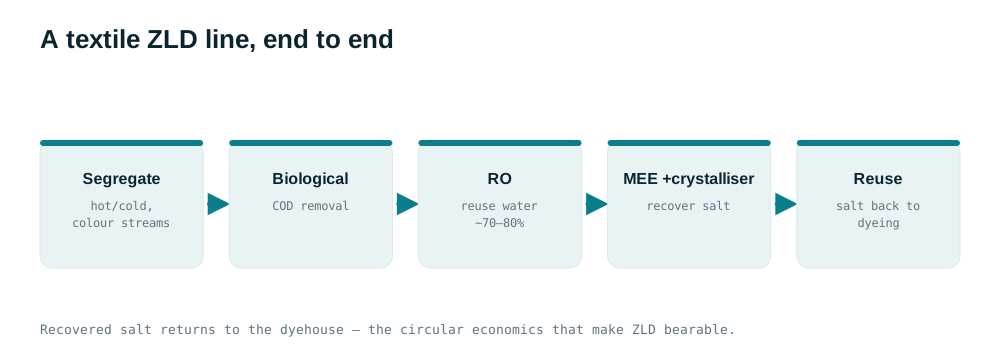
- Segregate hot, cold and high-colour streams so each is treated for what it actually contains, and the expensive stages only see the concentrated fraction.
- Biological / advanced oxidation to knock down COD and break colour.
- Reverse osmosis to recover the bulk of clean water — typically 70–80% — for reuse.
- MEE and crystalliser to evaporate the RO reject and dry it to solids.
Why the salt is the point
The economics that make textile ZLD bearable hinge on salt recovery. The sodium sulphate or common salt that came in with the dyeing process can be recovered from the crystalliser and returned to the dye house. The recovered water displaces fresh intake; the recovered salt displaces a purchase. Neither fully pays for the thermal energy ZLD consumes, but together they turn a pure compliance cost into a partial offset.
In a textile cluster, the plant that recovers both water and salt is not just satisfying the pollution board — it is buying back two of its own raw materials from its waste stream.
The engineering judgement that matters
The difference between a textile ZLD plant that runs and one that fights its operators is almost always upstream of the membranes. High colour and high TDS punish a poorly conditioned RO: fouling rises, recovery falls, and the load shunts onto the energy-hungry evaporator. Tight pre-treatment, honest stream segregation, and a recovery split set from a real effluent analysis are what keep the thermal tail — and the running cost — under control.
The character of the effluent
A dye house stream is difficult in a specific way. It arrives hot (often 40–70°C), deeply coloured from reactive dyes that resist conventional biology, alkaline, and — critically — salty, because large quantities of common salt or Glauber's salt are dosed into the dye bath to drive fixation. It is the salt, more than the colour, that defines the road to zero discharge: RO can recover the water, but the salt it concentrates has to be crystallised out thermally, and that is the expensive end of the plant.
The treatment train
A typical route runs equalisation (to tame the swings in temperature, pH and load) → biological treatment for COD → a tertiary colour-removal step (coagulation, ozonation or another advanced oxidation process, or activated carbon) → RO for water recovery → MEE and ATFD to crystallise salt. Many small units rely on a shared Common Effluent Treatment Plant (CETP) for parts of this; larger processors increasingly build individual ZLD so they control their own compliance and their own water.
Recovering salt, not just water
The sharpest lever is stream segregation. The concentrated, salty dye-bath liquor and the dilute rinse water have very different economics: send everything through one train and you pay to evaporate water that a membrane could have removed cheaply. Keep them apart, and you can RO the dilute rinse for easy water recovery while routing only the truly salty fraction to the evaporator — and there, recovering Glauber's salt or sodium chloride in usable form can offset chemical purchases rather than producing a waste to landfill.
For Gujarat's processors, ZLD is no longer a question to debate. The useful work is in building it so that the same plant that keeps the licence also returns the most water and salt it economically can.