Digital water: what CPCB's OCEMS mandate means for your plant
Real-time effluent data now flows straight from the outfall to the regulator's servers. For many industries, online monitoring has become as much a part of the plant as the treatment train itself.
Compliance used to be a periodic inspection and a paper log. For India's most-watched industries, it is now a continuous, automated data feed running 24×7 from the plant's outfall to the regulator's servers. If you operate in a regulated sector, the Online Continuous Effluent (and Emission) Monitoring System — OCEMS — is no longer optional infrastructure.
What the mandate actually requires
Under the Water Act and Air Act, CPCB has directed the 17 categories of highly polluting industries to install OCEMS and connect the data live to State Pollution Control Board and CPCB servers. Analysers at the final outfall measure parameters such as pH, COD, TSS and flow continuously; central software watches the values, and if a parameter breaches its limit, an automatic SMS alert goes to the industry, the SPCB and CPCB at once.
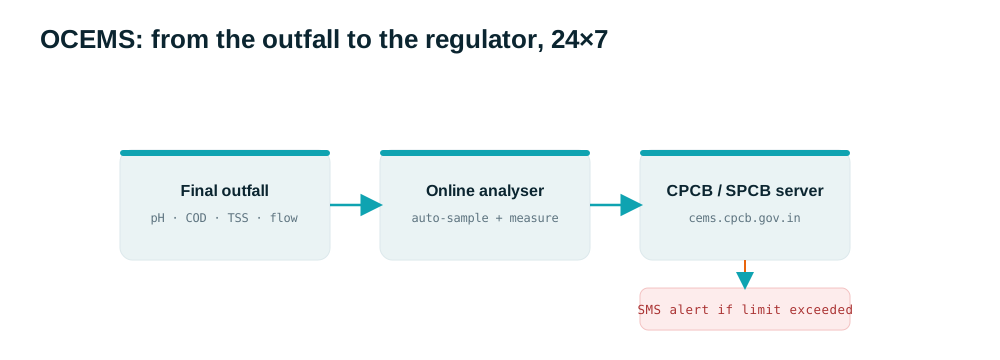
The regime keeps tightening. On 23 September 2025, CPCB issued a fresh directive moving industries onto a new OCEMS portal (cems.cpcb.gov.in), adding PTZ camera integration, geotagging of stations and revised calibration protocols. Separately, NCR-Delhi units in sectors including textile and food processing were directed to complete OCEMS and camera installation by 31 December 2025, with non-compliance risking closure.
The compliance gap is real
The mandate is not new, but adoption has lagged — which is precisely why enforcement is sharpening:
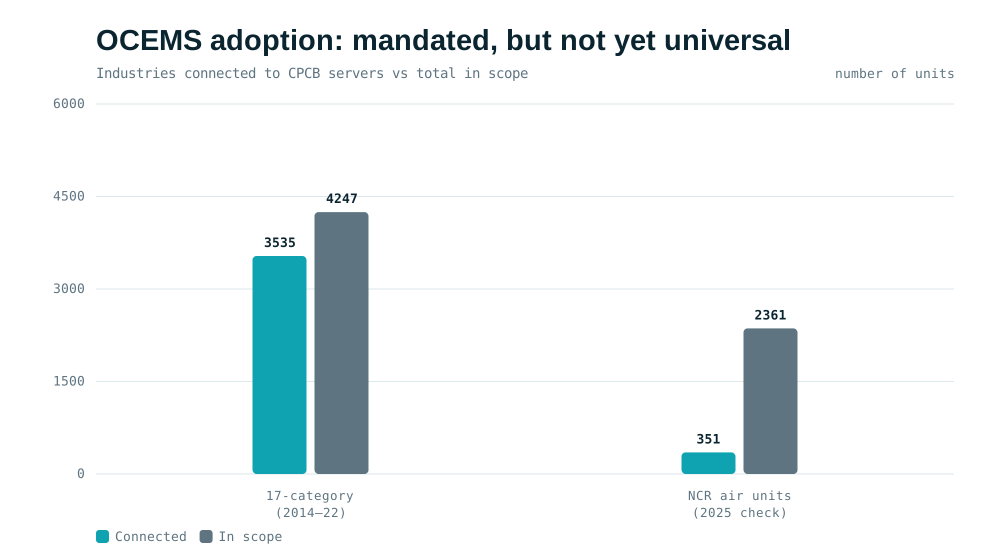
Between 2014 and 2022, of roughly 4,247 units in scope, about 3,535 installed and connected OCEMS. But a 2025 verification in the NCR found that of 2,361 air-polluting units checked, only 351 had connected — leaving over two thousand non-compliant. Penalties have been set as high as ₹1 crore, alongside the threat of closure.
Treating data as part of the plant
Done well, OCEMS is more than a regulatory box to tick:
- It is an early-warning system. A live COD or pH excursion is a process problem caught in minutes, not at the next manual sample.
- It rewards a stable plant. Continuous public data punishes a plant that lurches; it quietly advantages one that holds its numbers.
- It integrates with the treatment train. The same instrumentation that satisfies CPCB can drive dosing, alarms and operator response.
The plants that resent OCEMS treat it as surveillance. The ones that benefit treat it as a second set of eyes on the process — one that happens to keep the regulator satisfied at the same time.
What is actually mandated
OCEMS applies to the country's most-watched polluters — 17 categories of highly polluting industries plus common effluent and treatment facilities. The requirement is continuous, telemetered monitoring: sensors for parameters such as pH, a COD/BOD surrogate, total suspended solids and flow (and, for some sectors, specific species) streaming data 24×7 from the outfall to State and Central Pollution Control Board servers. A September 2025 directive sharpened enforcement, and units in the NCR were given a 31 December 2025 deadline to connect. The compliance gap is real: of roughly 4,247 units required to link effluent monitoring, about 3,535 were connected; on the emissions side only about 351 of 2,361. Non-compliance carries environmental compensation running to ₹1 crore.
Why it changes how a plant is designed
A continuous feed removes the place bad numbers used to hide. You can no longer average a difficult hour into an acceptable day; the limit has to hold minute by minute, in public. That pushes design toward buffering and equalisation so shock loads are smoothed, online dosing control so chemistry tracks the incoming load in real time, and a genuine treatment margin rather than a plant sized exactly to the limit on a good day. It also makes sensor upkeep part of operations — an uncalibrated probe trips false alarms and erodes trust in the data.
Turning the feed into an asset
The same data stream that polices the plant can run it. Continuous readings drive real-time dosing, flag a failing unit before it breaches, and reveal where the process wastes chemicals or energy. The plants that treat OCEMS as a control system rather than a reporting tax get the compliance for free and an optimisation tool on top — which is why the sensible move is to instrument the outfall and size the connectivity in from the start.
For a treatment plant being designed or upgraded today, the sensible move is to plan the monitoring in from the start: instrument the outfall, size the connectivity, and build the treatment so it can actually hold the limits the whole world can now watch in real time.